
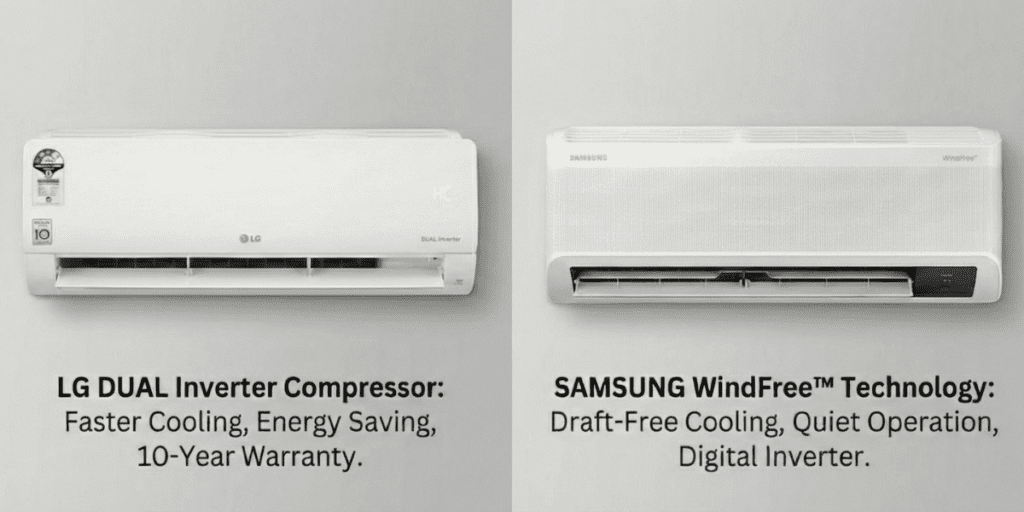
Buying an AC in India has changed. In 2026, you can’t just walk into a store and pick a “5-star” model anymore.
Between new government energy rules and the reality of Indian summers, the “best” brand isn’t always the one with the biggest ad.
If you are stuck between an LG and a Samsung AC, you aren’t alone. One brand promises the best service, while the other promises the smartest features.
But which one actually chills your room when it’s 45°C in Delhi? And which one won’t leak gas after just one year?
We’ve ignored the marketing brochures and looked at the raw data. We scanned forums like Reddit and Team-BHP to find the problems real Indian users are facing right now.
In this LG vs Samsung AC guide, we compare the two most popular models on Amazon: the LG AI DUAL Inverter (US-Q19MWZE) and the Samsung Bespoke AI (AR60F19D15WNNA).
We will show you which one fits your home, your city, and your budget.
Also learn about LG and Bluestar AC comparisoin.
LG vs Samsung ac : 30 Second Comparison
| What You Need | LG (US-Q19PWZE) | Samsung (AR60F) | Reason |
|---|---|---|---|
| Best For | Durability & Hall/Office | Sleep & Quiet Bedrooms | Decision |
| Cooling Comfort | Powerful, direct cold air | No-Draft (WindFree) | Samsung wins for comfort |
| Noise Level | Quiet (31 dB) | Silent (24 dB) | Samsung is whisper-quiet |
| Rust Protection | Ocean Black Coating | Durafin Ultra | LG survives “naalas” longer |
| Energy Saving | Higher (5.20 ISEER) | High (5.15 ISEER) | LG is slightly more efficient |
| Peace of Mind | 1 Yr Product Warranty | 5 Yr Comprehensive | Samsung covers all repairs |
| Winner | The Reliability King | The Comfort King | Your Choice |
| Check Price on Amazon | Add To Cart | Add To Cart |
The LG Advantage: Reliable & Rugged
- Best for Polluted Cities: If you live near an open drain (naala) in Noida or a coastal area like Mumbai, LG is the safer bet. Its Ocean Black Protection is a thick coating that prevents gas leaks caused by sulfur and salt air.
- Simple to Use: LG’s remote and settings are straightforward. It is perfect for parents or anyone who wants a “set it and forget it” machine.
- Service Reach: LG has a massive network of in-house technicians. In cities like Jaipur or Indore, getting a part replaced is usually faster than other brands.
Also read our comparison blog post on: LG vs Daikin AC
The Samsung Advantage: Smart & Silent
- Perfect for Light Sleepers: These ACs are incredibly quiet. In silent mode, the noise drops to 24 dB. That is quieter than a whisper.
- Ultimate Convenience: You can control the Bespoke AI model using your phone or voice (Alexa/Google). It learns your habits and adjusts the temperature automatically.
- Zero-Tension Warranty: Samsung often provides a 5-year comprehensive warranty. This covers expensive parts like the PCB and gas refills for half a decade.
Quick Note: The 2026 “Star Rating” Warning
Before you swipe your card, there is something you need to know that most salesmen won’t tell you. On January 1, 2026, the rules for Star Ratings in India changed completely.
The “5-Star” AC you saw in the shop last year? If that same machine was tested today, it would probably only get a 4-Star rating.
Here is the deal for 2026:
- The New “Gold Standard”: To be a real 5-Star AC this year, a machine needs an ISEER of 5.30 or higher. Anything lower is basically last year’s tech in a new box.
- How to check: Look at the BEE sticker on the front. If the “Validity Period” says 2024-2025, that’s old stock. If it says 2026-2028, you’re looking at the latest, most efficient tech.
- My Advice: If you find a 2025 model you love, haggle for a discount. Tell the dealer you know it’s “technically outdated” now. You might save an extra ₹3,000–₹5,000 just by pointing this out.
Note: For this guide, I looked at the 2025 5-Star models because they are the most popular right now. But if you see a newer 2026-rated model with an ISEER above 5.30, grab that one instead. It’ll pay for itself in lower electricity bills within a couple of summers.
Performance in Extreme Indian Heat (45°C – 58°C)
When the temperature hits 45°C in Rajasthan or UP, most ACs struggle to keep the room chilled. In 2026, the real test of an AC isn’t just “cooling”—it’s whether the machine keeps running or “trips” (shuts down) when the sun is baking the outdoor unit.
LG US-Q19PWZE: The “Instant Chill” Specialist
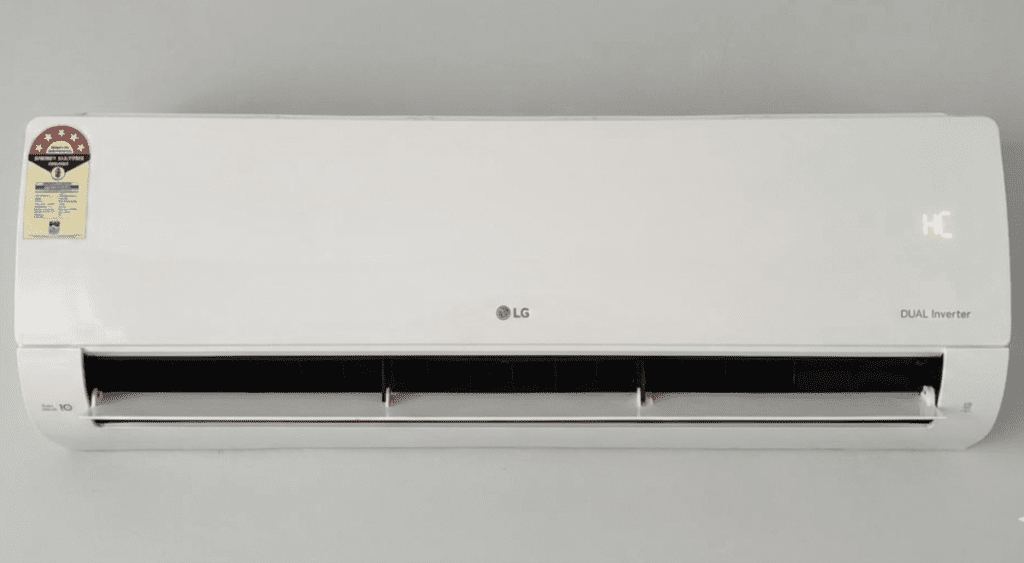
LG is built for those who want relief the moment they step inside.
- The Benefit: If you’ve just come home from the office to a room that feels like a furnace, LG’s VIRAAT Mode is a lifesaver. It “overclocks” the Cooling Capacity to 116% (5800W), forcing a massive volume of cold air into the room to drop the temperature in under 5 minutes.
- The Air Throw: LG features a superior Air Throw Distance of up to 15 meters. If you have a long living room, LG is better at pushing that cold air all the way to the far corner.
- The Tech: It uses ADC Safety Sensors to monitor the outdoor heat and gas pressure. This acts like a brain, adjusting the compressor so the AC never stops cooling, even when the outside temperature hits 55°C.
Samsung AR60F19D15WNNA: The “Heat-Wave” Survivor
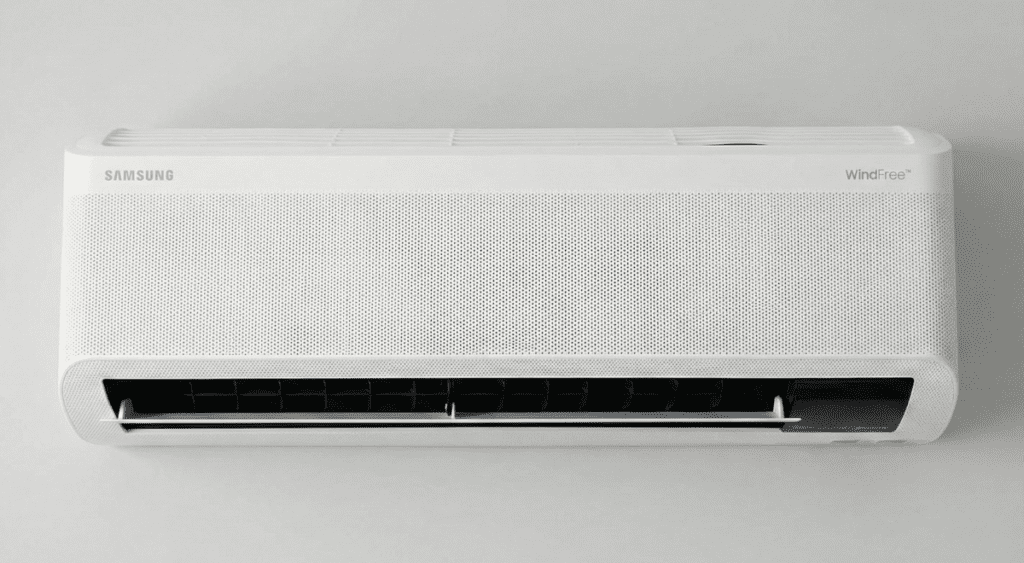
Samsung’s Bespoke AI series is designed for “worst-case scenario” heat.
- The Benefit: While most ACs stop working at 52°C, this Samsung model is rated for High Ambient Operations up to a staggering 58°C. If your outdoor unit is stuck in a small, unventilated balcony where heat gets trapped, the Samsung is much less likely to shut down.
- The Tech: In Party Mode, it delivers a massive 6000W of Cooling Power (the highest in its class). But the real magic is the Temperature Stability. While standard ACs fluctuate by 1-2 degrees, Samsung’s WindFree technology maintains the room within ±0.3°C. You won’t wake up at 3 AM feeling “too cold” or “too sweaty.”
- Cooling Uniformity: Samsung is better at ensuring the entire room is cool. Because of the 23,000 WindFree holes, there are no “hot spots” or “cold zones”—the chill is perfectly even.
Performance Comparison at a Glance
| Feature | LG (The Sprinter) | Samsung (The Marathoner) |
|---|---|---|
| Max Power Boost | 5800W (VIRAAT) | 6000W (Party Mode) |
| Heat Tolerance | Up to 55°C | Up to 58°C |
| Air Throw | Better for Long Rooms | Better for Even Cooling |
| Stability | ±1.4°C Variance | ±0.3°C (Superior) |
| Voltage Range | 120V – 290V | 130V – 290V |
LG vs Samsung: Detailed 3-Year Ownership Cost (2026 Estimate)
To help you make a final decision, let’s look at the “hidden costs” that most people ignore. When you buy an AC, the sticker price is just the beginning. You also have to pay for installation, regular servicing, and the electricity it gulps every month.
Here is a detailed 3-year cost breakdown for the LG US-Q19PWZE and the Samsung AR60F19D15WNNA based on average Indian usage (8 hours/day for 180 days a year at ₹8 per unit).
| Cost Category | LG (US-Q19PWZE) | Samsung (AR60F) | Explanation |
|---|---|---|---|
| Purchase Price | ~₹48,500 approx | ~₹44,500 approx | Samsung is generally cheaper to buy upfront. |
| Standard Installation | ~₹1,200 | ~₹499 (Offer) | Samsung often runs “Discounted Installation” promos. |
| Electricity (Year 1) | ~₹5,956 | ~₹6,010 | LG saves a few units due to higher efficiency. |
| Electricity (Year 2) | ~₹5,956 | ~₹6,010 | Based on 5-Star BEE 2025 ratings. |
| Electricity (Year 3) | ~₹5,956 | ~₹6,010 | (745 units LG vs 751 units Samsung). |
| Mandatory Servicing | ~₹3,000 | ₹0 (Included) | Samsung’s 5yr warranty requires official service. |
| Repair Buffer (PCB/Gas) | ₹5,000 (Risk) | ₹0 (Covered) | Samsung’s warranty covers PCB & Gas for 5 years. |
| Total 3-Year Spend | ₹75,558 | ₹63,019 | Samsung saves you ~₹12,500 over 3 years. |
How They Save You Money (AI & Convertible Modes)
While the table above shows the “Standard” cost, you can actually lower these bills significantly by using the built-in smart features.
LG: The “Manual Control” Saver
- Convertible 6-in-1: If you are alone in the room, switch to 40% Mode. It’s like turning your 1.5-ton AC into a 0.7-ton unit.
- AI+ Mode: LG’s AI sensors “feel” the room heat. If the room is already cold, it automatically drops the power level for you, so you don’t waste money.
- Maintenance Saver: LG’s Low Gas Detection warns you before the gas is empty. This prevents your compressor from burning out; a repair that can cost over ₹10,000.
Samsung: The “Fully Automated” Saver
- Convertible 5-in-1: While it has one less step than LG, its Party Mode (120%) is great for quickly cooling a room full of people so you don’t have to run it at high speed for hours.
- Bespoke AI Energy Mode: This is the game-changer. Through the SmartThings App, the AI tracks your daily units. It can even set a “Monthly Goal” (e.g., ₹2,000) and adjust the AC power to make sure you don’t exceed it.
- WindFree Savings: By closing the flap and using 23,000 micro-holes, the AC uses much less power to maintain the temperature compared to standard blowing.
Final Verdict on Value
- The “Budget-Safe” Winner: Samsung. Because of the 5-Year Comprehensive Warranty, Samsung is the clear winner for your wallet. It protects you from the two most expensive repairs in India: PCB failure and Gas Leaks.
- The “Efficiency” Winner: LG. If you plan to keep the AC for more than 7–8 years and live in a high-pollution area, LG’s Ocean Black Protection will prevent leaks better in the long run, eventually paying back its higher starting price.
Service & Support: Who Actually Shows Up?
LG: The “Widespread Hero”
LG is widely considered the king of service reach in India.
The Benefit: If you live in a Tier-2 or Tier-3 city (like Jaipur, Indore, or smaller towns), LG almost certainly has a service center nearby. Because they use a higher percentage of in-house technicians rather than third-party contractors, their response time is typically within 24 to 48 hours.
Smart Diagnosis: Use the LG ThinQ App to run a “Smart Diagnosis.” It tells the technician exactly what is wrong via your phone before they arrive, which helps them bring the right spare parts on the first visit.
Samsung: The “Warranty Specialist”
Samsung has a massive network in metros but focuses heavily on “Financial Protection.”
The Benefit: Samsung’s star feature is its 5-Year Comprehensive Warranty. For the first five years, Samsung is responsible for almost everything—from Gas Refills to the PCB (the computer chip). In major cities, this “Zero-Tension” model is unbeatable.
Smart Support: Their SmartThings App allows for remote monitoring and live service request tracking, so you aren’t left wondering where the technician is.
Before You Buy: The “Pincode Test”
Even the best brand is useless if their center is 100km away. Use these official links to check your area:
- LG Service Center Locator: Enter your pincode to see the nearest authorized center.
- Samsung Service Center Locator: Check if they have a dedicated “Plaza” or authorized point in your city.
Service Quality: The Community Verdict
| Feature | LG (The Veteran) | Samsung (The Modernist) |
|---|---|---|
| Service Network | Largest in India (Winner for small towns) | Excellent in Metros/Cities |
| Response Time | Usually 1-day service | Usually 2-day service |
| Real User Rating | 4.8/5 (Reliable Reach) | 4.3/5 (Feature-rich but varied) |
| Warranty Support | Standard 1+5+10 Years | Best 5 Year Full Warranty |
LG vs Samsung: Whose Installation Service is Better?
When you book an installation in 2026, the brand you choose determines who enters your home:
LG (The In-House Advantage)
LG is widely praised on forums like Team-BHP for having more in-house technicians. This means the person installing your AC is an LG employee, not a third-party contractor. They are generally better trained on specific features like the ADC sensors and are less likely to “rush” the job.
Samsung (The Third-Party Risk)
Samsung often relies on authorized service partners. While excellent in metros, the quality can vary in smaller towns. However, Samsung’s SmartThings App allows for the best live tracking—you can see exactly when the technician is arriving, which is a big win for busy professionals.
| Metric | LG Installation | Samsung Installation |
|---|---|---|
| Ease of Booking | Excellent (ThinQ App) | Best (SmartThings Tracking) |
| Technician Type | Mostly In-House | Mostly Authorized Partners |
| Common Complaint | Pushy about AMC sales | Speed vs. Quality balance |
| Installation Price | ~₹1,200 – ₹1,500 | Often Discounted (₹499-999) |
Tip: “Take a photo of the Copper Pipe Joint outside once they finish. If you see any oily residue later, it’s a sign of a gas leak. Having that photo helps you claim a free repair under the installation warranty!”
Bonus: The “Installation Day” 3-Point Checklist
Critical Warning: Do not share your Installation OTP with the technician until the unit is on your wall and cooling. Once you give that code, your leverage is gone.
1. The Mandatory Vacuuming (15-20 Minutes)
This is the #1 mistake in India. Technicians often skip this to save time, claiming “inverter ACs don’t need it.”
- Why it matters: If air or moisture remains in the pipes, it reacts with the refrigerant to form acid, which eats your copper coils from the inside. This is why ACs “randomly” leak gas after 14 months.
- The Check: Insist they use an actual Vacuum Pump machine. Do not let them just “purge” the air using the gas from the cylinder.
2. The “Backlight” Workaround (For LG Users)
As noted by many on MouthShut, the LG remote often lacks a backlight.
- The Check: While the technician is there, have them help you set up the LG ThinQ App. Since the remote is hard to see at night, the app will become your primary way to change the temperature without turning on the lights.
3. The “WindFree” Dust Shield (For Samsung Users)
Samsung’s 23,000 micro-holes are a magnet for drilling dust.
- The Check: Ensure the technician covers the indoor unit with a plastic sheet while drilling the hole in your wall. If white cement dust enters those holes, you might get a musty smell or reduced airflow within weeks.
Conclusion: Samsung Vs LG AC
Choosing between the LG US-Q19PWZE and the Samsung AR60F comes down to your living situation and your tolerance for “repair anxiety.”
Choose the LG US-Q19PWZE if: You live in a high-pollution area, near a coastal region, or close to an open drain (naala). Its Ocean Black Protection is the best defense against gas leaks. It’s a “rugged” machine designed for harsh Indian conditions and offers the fastest service in smaller towns.
Choose the Samsung AR60F if: You are buying an AC for a bedroom or a home office. The WindFree technology is a game-changer for people who hate direct cold drafts, and the 5-Year Comprehensive Warranty offers the best financial protection in the market today.
The Final Word: If you want a “tough” machine that chills fast, go with LG. If you want a “smart” machine that protects your wallet from repair costs, go with Samsung.
FAQs on: LG vs Samsung AC
1. Is a 2025 5-Star AC still good in 2026?
Yes, but with a catch. On January 1, 2026, the BEE ratings were updated. A “5-Star” model from 2025 is now roughly equivalent to a “4-Star” in 2026 efficiency. If you find a 2025 model at a deep discount (₹5,000+ off), it is a great deal. If the price is the same, always buy the 2026-rated model.
2. Does Samsung’s WindFree technology really save electricity?
Yes. Once the room reaches your target temperature, switching to WindFree mode can save up to 77% energy compared to “Fast Cooling” mode. This is because it uses the 23,000 micro-holes to maintain the chill rather than running the heavy blower fan at high speed.
3. Why is everyone talking about “Vacuuming” during installation?
Because it’s the #1 reason for AC failure in India. If the technician doesn’t use a vacuum pump to remove air and moisture from the copper pipes, it creates acid that causes internal corrosion and gas leaks. Always insist on a 15-minute vacuum process before they release the gas.
4. Does LG’s “6-in-1” cooling actually work or is it a gimmick?
It works! By limiting the AC to 40% or 60% capacity using the remote, you are manually capping the power the compressor can draw. This is the most effective way to lower your electricity bill if you are the only person in the room.
5. Can I use these ACs without a stabilizer?
Both models feature “Stabilizer-Free Operation” (usually between 120V-290V). However, if you live in an area with frequent power cuts or extreme voltage spikes, we still recommend a dedicated 4kVA stabilizer to protect the sensitive AI circuit boards (PCBs).
6. How often should I clean the filters?
In dusty Indian cities, you should clean the mesh filters every 2 weeks. For Samsung WindFree models, use the “Auto-Clean” feature every time you turn off the AC to prevent moisture and mold from building up in the micro-holes.

