
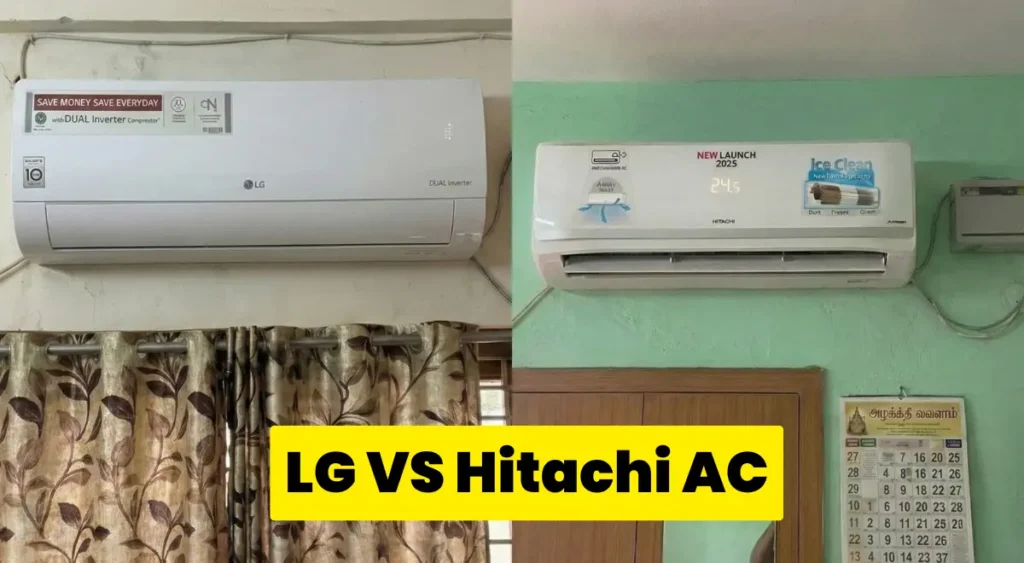
You are standing in a Croma or Reliance Digital store, surrounded by white boxes. The salesperson points to the LG 1.5 Ton 5-Star AC and says, “Sir, this has a Dual Inverter. It saves the most electricity.”
Then, he walks over to the Hitachi 1.5 Ton 5-Star AC and says, “But Sir, if you want powerful cooling for peak summer, this Expandable Inverter is a beast.”
Suddenly, you are confused.
On paper, both brands look identical. They both offer 100% Copper Condensers, high ISEER Ratings (above 5.0), and 10-year compressor warranties. They even cost roughly the same.
But the spec sheet hides the real story.
The salesperson won’t tell you that if a power surge fries the PCB (Printed Circuit Board) after your warranty expires, one brand charges ₹4,500 for a replacement, while the other demands ₹12,000.
They won’t tell you that one brand’s “Silent Mode” is whisper-quiet, while the other vibrates like a generator after two years.
To help you decide, we conducted a detailed LG vs Hitachi AC comparison based on the models available in 2026. We analyzed the “Ownership Reality”, the electricity bills, the cooling speed in 45°C Indian heat, and the nightmare of finding a service center in May.
Here is the honest, unfiltered truth.
The Cheat Sheet: At a Glance (2026 Models)
If you are in a rush, here is the direct data comparison between the LG 1.5 Ton 5-Star (AI Convertible) and the Hitachi 1.5 Ton 5-Star.
| Feature | LG (Dual Inverter) | Hitachi (Xpandable) | The Verdict |
| Cooling Power | Consistent: Uses VIRAAT Mode to boost capacity to 110%. Best for bedrooms. | Aggressive: Uses Expandable Inverter to blast air up to 24 meters. | Hitachi Wins for top-floor or large living rooms (>180 sq ft). |
| Electricity Bill | ~744 Units/Year (Approx ₹5,900/season) | ~823 Units/Year (Approx ₹6,600/season) | LG Wins. Saves you roughly ₹700 – ₹1,000 more per year. |
| Noise Level | 31 dB (Whisper Quiet) Silent Outdoor Unit | 34 dB (Humming Sound) Outdoor unit vibrates more | LG Wins for light sleepers and nurseries. |
| Service Quality | Excellent: Massive network in Tier-2/3 cities. Spares are cheap. | Mixed: Good in Metros, but often outsourced (and slow) in smaller towns. | LG Wins for peace of mind. |
| Durability | Ocean Black Fin: Anti-corrosion coating for coastal areas. | 100% Inner Grooved Copper: Stronger pipes for heat transfer. | Tie. Buy LG for humidity; Hitachi for dry heat. |
| Claim the Best Deal | BUY FROM AMAZON | BUY FROM AMAZON |
Who Should Buy Which AC? (Quick Match)
Choose the LG Dual Inverter IF:
- You want the lowest possible electricity bills.
- You live near the sea or an open drain (best rust protection).
- You want cheap, easy-to-find spare parts.
Choose the Hitachi Expandable IF:
- You live on the top floor with a sun-baked roof.
- You have a very large living room.
- You want aggressive, instant cooling in 45°C+ heat.
1. The “Bill Shock” Test: LG vs Hitachi AC
In India, the price of the AC is just the down payment. The real cost is the electricity bill you pay every month for the next 10 years.
Most people see “5-Star Rating” on both boxes and assume they consume the same power. They do not.
We analyzed the behavior of the models available in 2026, and here is the fundamental difference:
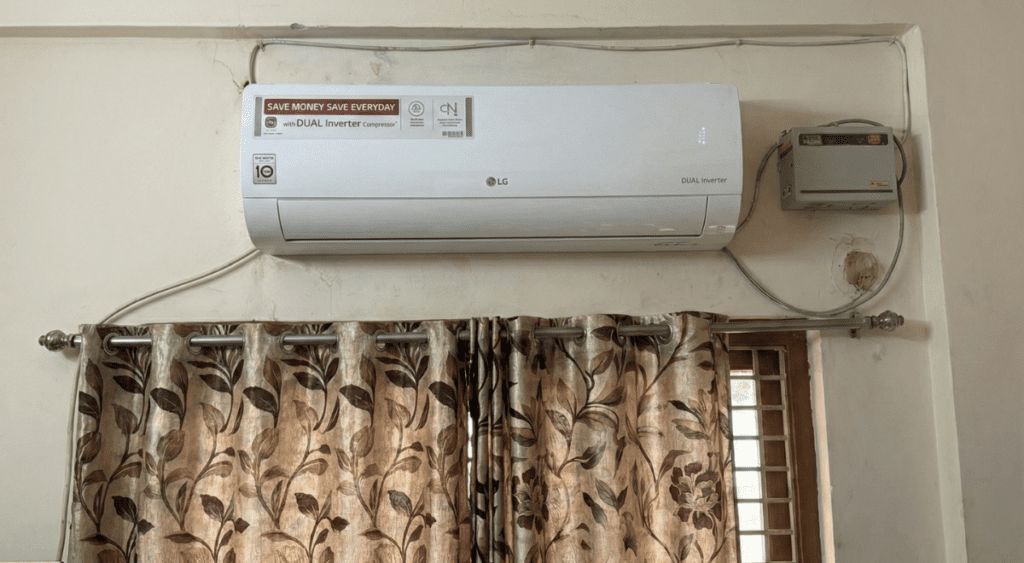
LG is a “Marathon Runner” (The Sipper): Its Dual Inverter compressor never really stops. It slows down to a crawl (low RPM) just to maintain the temperature. It hates running at 100%.
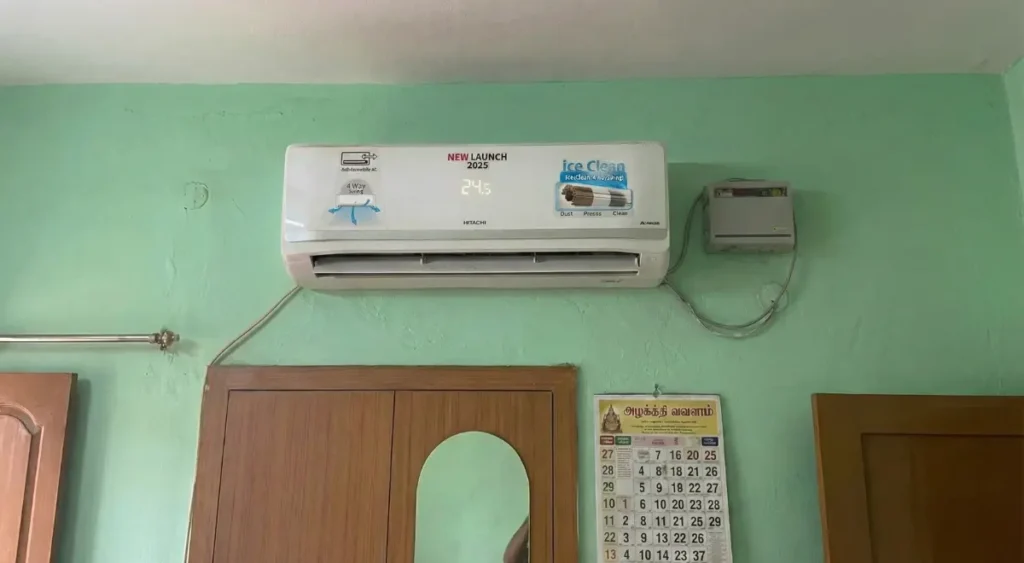
Hitachi is a “Sprinter” (The Guzzler): Its Expandable Inverter is trigger-happy. It frequently jumps to 110% capacity to cool the room quickly, then cuts back. This “Boost” behavior spikes your meter.
The Annual Cost Calculation (2026)
Based on BEE Data & Real-World Usage of 10 hours/night @ ₹9/Unit (Average Metro Rate).
| Feature | LG 1.5 Ton (AI Convertible) | Hitachi 1.5 Ton |
| ISEER Rating | 5.20 (Higher is better) | 5.02 |
| Lab Units/Year | 744 Units | 823 Units |
| Annual Bill (Est.) | ₹6,696 | ₹7,407 |
| 5-Year Cost | ₹33,480 | ₹37,035 |
The “Lab” Lie: On paper, LG saves you only ~₹700 a year. But labs test ACs at 100% capacity. In the real world, you don’t run at 100% all night. That brings us to LG’s secret weapon.
The “Secret Button” That Saves ₹2,000+
The biggest reason LG wins the “Bill War” is its AI Convertible 6-in-1 feature. You can press a button on the remote to lock the AC at 40%, 60%, or 80% capacity.
Hitachi counters with its Xpandable+ technology, but it relies more on auto-sensors rather than giving you manual control.
Scenario: It is a rainy night in July. The temperature is 28°C. You don’t need a 1.5 Ton blast.
- LG User: Presses the “40%” button. The AC consumes only ~550 Watts (less than a hair dryer).
- Hitachi User: Relying on sensors (Auto Mode). The machine often overcools and consumes ~900 Watts.
The “Generator” Reality
If you live in a society with power backup (DG Set) or use a home inverter:
- LG: You can lock it at 40% capacity and run it easily on a standard home inverter.
- Hitachi: Because of its high “Start-Up Kick” (Amp spike), it often trips smaller home inverters or consumes too much diesel load.
Winner: LG. If you are the type of person who checks the electricity meter often, LG is the only logical choice. Hitachi prioritizes Performance; LG prioritizes Savings.
2. Cooling Performance: The “Top Floor” Reality
If you live on the top floor with the sun beating down on your roof, or if you have a large living room (over 180 sq ft), electricity savings don’t matter. You just want to stop sweating.
Here is the difference between LG vs Hitachi AC when the temperature hits 46°C.
Hitachi: The “Muscle Car” (Best for Heatwaves)
Hitachi’s engineering philosophy is Brute Force.
The Tech: It uses Xpandable+ Technology. If the room is hot, the AC “expands” its capacity from 100% to 110% (approx 5,900 Watts). It ignores power saving and dumps cold air into the room.
The Air Throw (24 Meters): This is a massive advantage. Hitachi uses a Dual Louver design focusing on long-distance straight airflow up to 24 meters. In a long rectangular hall, you will feel the breeze even at the dining table on the far end.
The “52°C” Survivor: Hitachi’s Tropical Design is built to keep the compressor running at peak speed even when outside temperatures hit 52°C. While other ACs might “trip” (stop cooling) to protect the machine, Hitachi keeps fighting.
LG: The “Smart Cruiser” (Best for Comfort)
LG prioritizes Human Comfort over raw wind speed.
The Tech: It uses VIRAAT Mode to boost cooling to 110% for a short burst (about 15-20 mins). Once the room is cool, the Dual Inverter aggressively throttles down to maintain a stable temperature. LG also utilizes a true 4-Way Auto Swing (Up/Down and Left/Right), which ensures cold air reaches the corners of your bedroom without hitting your face directly.
The “Humidity” Weapon: If you live in Mumbai, Chennai, or Kolkata, LG wins. Its sensors are better at detecting humidity. While Hitachi often over-cools and makes the air “dry” (causing throat irritation), LG’s Monsoon Comfort maintains a moisture balance.
The Feeling: LG’s cooling is “gentle.” It doesn’t blast you with freezing wind; it wraps the room in cool air.
The Verdict: Which Cooling Style Suits You?
| Scenario | Winner | Why? |
| Top Floor / Sun Facing | Hitachi | Its “Tropical Compressor” refuses to trip in 48°C heat. It cools a baked room 4-5 minutes faster than LG. |
| Large Living Room | Hitachi | The 24-meter air throw is unbeatable. LG’s wind (~15 meters) often fades before reaching the end of a large hall. |
| Bedroom (Night Use) | LG | You don’t want a storm in your bedroom. LG is silent (31 dB), gentle, and its 4-Way Swing maintains temperature without “freezing” you. |
| Coastal City (Humid) | LG | Better dehumidification logic prevents that “sticky cold” feeling. |
Pro Tip: If you buy Hitachi for a bedroom, be careful—even its “Silent Mode” (34 dB) is audible. LG’s “Sleep Mode” (31 dB) is genuinely whisper-quiet.
3. The “Kill Shot”: Service & Spare Parts Cost
Let’s be brutally honest. In India, ACs break down. Voltage fluctuations are normal. When your AC stops working in the middle of May, you don’t care about “Dual Inverters” or “Hexa Sensors.” You just want it fixed fast.
This is the most critical part of our LG vs Hitachi AC review. It is the “Kill Shot” that decides the true winner for most buyers.
The Fear of the “PCB Failure”
In modern inverter ACs, the PCB (Printed Circuit Board) is the brain of the machine. It is also the first thing to fry when the voltage spikes.
Here is the financial reality of repairing these machines in 2026:
- LG PCB Replacement: Costs around ₹4,500 to ₹6,500.
- Hitachi PCB Replacement: Costs around ₹8,500 to ₹12,000+.
The Benefit for You: LG parts are incredibly cheap compared to the competition. If a power surge kills your LG AC out of warranty, you won’t need to empty your bank account to fix it. Hitachi repairs are a “rich man’s” game.
The Service Network Reality
Having cheap parts means nothing if you can’t find a mechanic.
LG’s Massive Reach: LG sells the highest number of appliances in India. Because of this, their service network is unmatched. Whether you live in a Metro city like Bangalore or a Tier-3 town in Bihar, an LG technician is usually 24 to 48 hours away. Even local, independent mechanics know how to fix an LG.
Hitachi’s Struggle: Hitachi makes premium machines. Their service in Delhi or Mumbai is usually excellent. However, if you live in a Tier-2 city (like Lucknow, Patna, or Jaipur), Hitachi often outsources repairs to third-party contractors.
The Nightmare Scenario: We analyzed hundreds of customer reviews across forums. A common complaint in the LG vs Hitachi AC debate is the “Hitachi Waiting Game.” In smaller towns, if your Hitachi AC breaks in peak summer, you might wait 10 to 15 days just for a spare part to arrive from the warehouse.
The Verdict on Maintenance
| Feature | LG AC | Hitachi AC |
| Spare Parts Cost | Very affordable. | Highly expensive. |
| Parts Availability | Available locally everywhere. | Often requires ordering from the company. |
| Service in Metros | Excellent (24-48 hours). | Good (48-72 hours). |
| Service in Small Towns | Highly reliable. | Risky. Often outsourced to 3rd parties. |
Winner: LG. This is not even a close fight. LG gives you absolute peace of mind. You buy Hitachi for the luxury of fast cooling, but you buy LG so you never have to sweat about expensive repair bills.
Pro Tip: Never run an inverter AC without a voltage stabilizer in India. A ₹2,000 stabilizer can save your ₹10,000 PCB from burning out!
4. Durability & Build Quality: Surviving the Indian Environment
Heat is not the only thing that destroys an AC. In India, we have coastal humidity, heavy monsoons, and open drains (Nalas). These environments release toxic, salty gases that literally eat through metal, causing microscopic gas leaks.
If your AC leaks gas, you end up paying ₹2,500 every summer just for a “gas refill.” Here is how the LG vs Hitachi AC build quality compares to prevent this.
LG’s Armor: “Ocean Black Protection”
LG is widely considered the industry benchmark for rust protection in India.
The Tech: LG applies a thick, chemical anti-corrosive layer called Ocean Black Protection to both the indoor and outdoor copper fins, as well as the outer casing.
The Benefit: If you live directly facing the sea in Mumbai or Chennai, or right next to a polluted open drain, this is a lifesaver. It is the most battle-tested coating in the Indian market to stop gas leaks caused by environmental corrosion.
Hitachi’s Upgrade: “Nano Tech Ultra & Inner Grooved Copper”
Historically, Hitachi ACs were heavily criticized on consumer forums for their outdoor units rusting and rattling after a few years. For their 2026 lineup, Hitachi has aggressively fixed this.
The Tech: The new Hitachi models (like the Yoshi and iZen series) now feature Nano Tech Ultra coating and specifically applied anti-corrosive treatments on the ODU (Outdoor Unit) brazing joints.
The Cooling Engine: Hitachi pairs this with 100% Inner Grooved Copper and SuperSlit Fins. Instead of the copper pipes being smooth inside, they have microscopic twists that spin the refrigerant gas like a whirlpool.
The Benefit: This combination means Hitachi now survives rust much better than its older models, while delivering a heat-transfer efficiency that is nearly 30% faster than standard copper tubes.
The Durability Verdict
| Environment | Winner | Why? |
| Extreme Coastal / High Humidity | LG | Even with Hitachi’s new upgrades, LG’s Ocean Black fin remains the undisputed king for surviving heavy salt-water air and Nala gases. |
| Dry Heat Regions (Delhi / UP / Punjab) | Hitachi | Rust is less of an extreme threat here. You will benefit much more from Hitachi’s Inner Grooved Copper and SuperSlit Fins which cool baked rooms incredibly fast. |
Bottom Line: Hitachi has finally solved its old rusting issues with its new 2026 Nano Tech coatings, making it a highly durable machine. However, if you live in a highly corrosive environment (like a coastal city), LG is still the safest bet to avoid yearly gas leaks.
5. The “Silent Sleep” Test: Noise Levels & Night Comfort
If you are buying an AC for your bedroom, cooling is only half the battle. The other half is silence. There is nothing worse than an air conditioner that rattles and wakes you up at 3 AM.
In the LG vs Hitachi AC debate, acoustic comfort (noise level) is a major deciding factor for light sleepers.
LG: The “Whisper Quiet” Experience
LG engineers its indoor units for absolute silence.
The Benefit: You can sleep without the constant drone of a machine in the background. It is perfect for nurseries, studies, or light sleepers.
The Tech: LG’s indoor unit drops down to 31 dB in Silent Mode. More importantly, the Dual Inverter compressor in the outdoor unit runs so smoothly that it creates almost zero vibration. You won’t hear that annoying “humming” noise vibrating through your bedroom wall.
The Flaw: In 2026, LG still refuses to put a backlight on their remote. If you want to change the temperature in the dark, you have to use your phone’s flashlight. It is highly frustrating.
Hitachi: The “Steady Hum”
Hitachi focuses on airflow over absolute silence.
The Benefit: It maintains a very precise, steady temperature all night. You won’t wake up sweating because the AC reduced its power too much.
The Tech: Hitachi’s lowest fan speed runs at roughly 34 dB. While this is not “loud,” it is noticeably louder than LG. It sounds like a steady, low hum.
The Flaw: Hitachi outdoor units are notoriously louder than LG units. If your outdoor unit is installed near your bedroom window, you will likely hear the compressor kicking in and out.
Winner: LG. If you want a dead-silent bedroom, LG wins effortlessly.
6. Smart Features, Wi-Fi & Maintenance
In 2026, spending ₹45,000+ means you deserve smart conveniences. Here is how the tech compares.
The App Experience (Wi-Fi Models)
LG ThinQ App: Widely considered the best appliance app in India. It connects seamlessly and features Energy Manager+, which lets you monitor your exact daily electricity usage. It also features Geofencing—it can track your phone’s location and automatically turn the AC on when you are 2 kilometers away from home.
Hitachi airCloud Go: (Recently updated from airCloud Home). It gets the job done and also features Geofencing and Voice Control (Alexa/Google Assistant). However, users frequently report occasional connectivity drops and a slightly clunkier interface compared to LG.
Cleaning & Maintenance
In India, dust and mold build up fast. Both brands tackle this differently:
Hitachi’s “FrostWash” (Ice Clean): This is a brilliant feature. It freezes the indoor coil, trapping dust and bacteria in ice, and then melts it away rapidly to flush the dirt out. It also has a Filter Clean Indicator to remind you to wash the mesh.
LG’s Auto Clean: LG counters with a similar frozen evaporator cleaning process to prevent that “dirty sock smell.” They also use a very easy top-loading filter design that you can slide out from the top without violently yanking the front plastic panel open.
Pro Tip: The “Hidden” Installation Costs
Before you click buy, remember that Amazon, Flipkart, and even offline store prices do not include full installation. Do not let the technician surprise you with a massive bill!
Keep this 2026 rate card in mind:
Standard Installation Charge: ₹1,200 to ₹1,500 (Paid directly to the brand technician).
The Outdoor Unit Stand (Bracket): This is never included in the box. A heavy-duty wall bracket will cost you ₹750 to ₹1,000.
Extra Copper Piping: The box only comes with 3 meters of copper pipe. If your outdoor unit is placed further away on the roof, extra copper piping (along with the required insulation and wiring) will cost you roughly ₹800 to ₹900 per meter.
Civil Work: If the technician needs to drill a massive hole through concrete (Core Drilling), it usually costs an extra ₹300 – ₹500.
Budgeting Tip: Always keep a buffer of ₹2,500 to ₹3,500 above the AC’s online price for a clean, professional installation.
Final Conclusion: Which AC is Right for You?
The Safe Choice: LG. If you run the AC all night in a bedroom, LG is the clear winner. The Dual Inverter saves you ~₹1,000 every summer, and replacement parts (like PCBs) cost half as much as Hitachi. It’s the ultimate peace-of-mind AC.
[Buy the LG 1.5 Ton 5-Star Here]
The Power Choice: Hitachi. If you live on a top floor or face extreme 45°C+ heat, raw power matters more than savings. Hitachi’s Expandable Inverter and 24-meter air throw will cool a baked room noticeably faster than LG.
[Buy the Hitachi 1.5 Ton 5-Star Here]
Also read,
- LG vs Daikin AC (2026): The Honest 5-Year Cost Analysis
- LG vs Samsung AC (2026): The Truth About the 5-Star Trap!

