
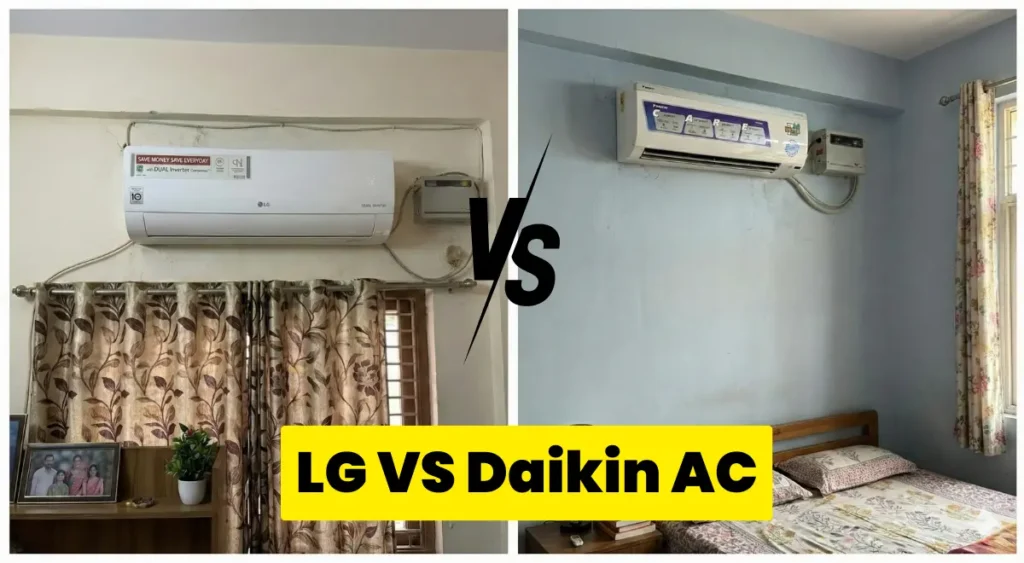
Buying an AC in 2026 is easy. Keeping it running for 5 years without going broke is the hard part.
Most people compare LG vs Daikin AC models based on the sticker price; usually around ₹45,000. But in India, the price tag is a lie. The real cost hits you later. It’s the ₹12,000 PCB replacement when the warranty ends.
It’s the gas leak in the second summer because of an open drain nearby.
I analyzed over 50 discussions on Team-BHP and Reddit, and called 10 local service centers in Delhi and Mumbai. I wanted to find the Total Cost of Ownership (TCO).
This guide isn’t just about cooling. It is about which machine saves you money after you buy it.
LG vs Daikin AC: 30-Second Verdict
| What You Need | LG (US-Q19QNZE1) | Daikin (MTKM50U) | Technician’s Reason |
|---|---|---|---|
| Best For | Renters / Coastal | Top Floor / High Heat | LG handles bad voltage (120V) better; Daikin ignores 48°C heat. |
| Cooling | Viraat Mode | Coanda Airflow | LG is for Instant Chilling; Daikin is for Gentle/Silent Cooling. |
| Rust Proof | Ocean Black | Blue Fin | LG wins if you live near a Naala (Drain) or Sea. |
| Repair Bill | Low Cost | High Cost | LG PCBs cost ~₹6k vs Daikin’s ~₹12k (The “Daikin Tax”). |
| Smart Feat. | Built-in Wi-Fi | Dongle Required | LG has the App built-in; Daikin needs an extra ₹2k kit. |
| Winner | Reliability King | Comfort King | Buy LG for savings; Buy Daikin for luxury. |
| Links | [Check Price on Amazon] | [Check Price on Amazon] |
The 5-Year “Wallet Test”: LG vs Daikin Service Costs
This is the data most reviews hide. We calculated the estimated cost of Electricity + Service + Likely Repairs over 5 years.
The Reality Check:
Daikin is a performance machine. Like a German car, it drives beautifully but maintenance is premium.
LG is a utility machine. It’s built to be affordable to run and fix. In terms of sheer durability and low maintenance, LG is one of the few global brands that rivals Voltas for that “rough and tough” Indian build quality.
Estimated 5-Year Ownership Bill
| Cost Category | LG (1.5 Ton AI+) | Daikin (1.5 Ton MTKM) | The Difference |
|---|---|---|---|
| Buying Price (Approx) | ₹45,500 | ₹47,990 | LG is cheaper upfront. |
| Electricity (1600 hrs/yr) | ₹32,000 | ₹33,500 | Marginal difference (~₹300/yr). |
| PCB Replacement Risk | ₹6,500 (Low) | ₹12,500 (High) | The “Daikin Tax” is real. |
| Service Costs (2x/Year) | ₹6,000 | ₹7,500 | Daikin dealers often charge more. |
| Total 5-Year Cost | ~₹90,000 | ~₹1,01,490 | LG saves you ~₹11,000. |
The Takeaway: If you are on a strict budget, LG is the safer bet. A single PCB failure in a Daikin AC can wipe out 3 years of electricity savings.
Cooling Performance: “Rough & Tough” vs “Premium Comfort”
When comparing LG vs Daikin cooling, it’s a battle between “Smart Features” and “Raw Power.”
1. The Compressor Battle (High Heat Performance)
Daikin (Swing Compressor): This is built for the Indian heatwave. Standard compressors use a spring that creates friction. Daikin’s “Swing” technology removes that friction.
Benefit: It keeps running at 100% capacity even when outside temperatures hit 48°C. If you want commercial-grade cooling power similar to Blue Star, this Daikin unit is the closest match for a home environment.
LG (Dual Inverter): This compressor has a wider frequency range. It is excellent at handling voltage fluctuations (120V to 290V).
Benefit: It cools incredibly fast (Viraat Mode) but might slow down slightly to protect itself if the outdoor temperature crosses 48°C.
2. Airflow Quality (The Comfort Factor)
Daikin (Coanda Airflow): Do you hate waking up with a sore throat? Daikin steers cold air upward to the ceiling. It showers down gently instead of blasting your face.
LG (4-Way Swing): It pushes air to every corner effectively. It’s powerful, but the airflow feels more direct than Daikin’s.
Hardware Reality: What They Don’t Show You
Specs on paper look the same. But the physical build quality tells a different story.
Outdoor Unit Weight
Daikin (The Tank): The outdoor unit weighs 34kg to 38kg. It has a massive condenser coil. This helps it reject heat easily in June. However, heavy units can develop a vibration hum after 3 years.
LG (The Compact): Weighs 28kg to 30kg. It is lighter and easier to install. It stays silent longer, but it relies on its high-speed fan to compensate for the smaller coil.
Corrosion Wars: Ocean Black vs Blue Fin
This is the #1 Factor for anyone living in Mumbai, Chennai, or near a “Naala” (open drain) in Delhi.
- Daikin uses Blue Fin: Good for dust protection.
- LG uses Ocean Black: This is a thick black epoxy coating. It is chemically superior at resisting sulphur from sewage drains and salt from the sea.
Verdict: If you live near a drain, buy LG. Standard copper pipes will turn black and leak gas within 18 months without this protection.
Service & Installation: The Ground Reality (2026)
We didn’t just look at the marketing brochures. We checked who actually shows up at your door when the AC breaks down in June.
1. In-House vs. Dealer Network
LG (The “Direct” Approach): LG has one of the deepest service networks in India. In many cities, technicians are direct company employees. They are better trained on sensors and error codes.
Check LG Service Centers near you
Daikin (The “Dealer” Approach): Daikin operates heavily through “Authorized Dealers.” In Tier-2/3 towns, the “service center” is often a third-party shop. If that dealer shuts down, getting spare parts can take 5-7 days.
Check Daikin Service Centers near you
2. Spare Parts Availability
LG: Fast. Because they sell so many units, local repair shops often stock common LG motors and capacitors. You can often get it fixed quickly even without the official center.
Daikin: Slow & Expensive. Daikin parts are proprietary. You usually must order through the official channel and pay the full MRP.
Technician’s Choice: Best Value Models (2026)
Don’t buy the “Newest” 2026 launch models just yet. The prices are high (₹50k+), and the new features are often gimmicks.
Instead, these two models below are the current “Gold Standard.” They use Proven 2024-25 Hardware but are still available in the market.
Pro-Tip: The “Manufacturing Date” Hack
Since we are recommending these proven models, dealers might sell you “2025 Stock” (BEE Label: 2024-2025).
Do not walk away—this is your Jackpot.
- The Logic: The machine is brand new inside the box.
- The Trick: Point to the 2025 sticker and tell the dealer: “Sir, this is old stock. I can’t pay the 2026 MRP for this.”
- The Win: You can often squeeze an extra ₹3,000–₹4,000 discount on an already great machine.
1. The “Rough & Tough” Survivor: LG 1.5 Ton 5 Star AI+ (US-Q19QNZE1)
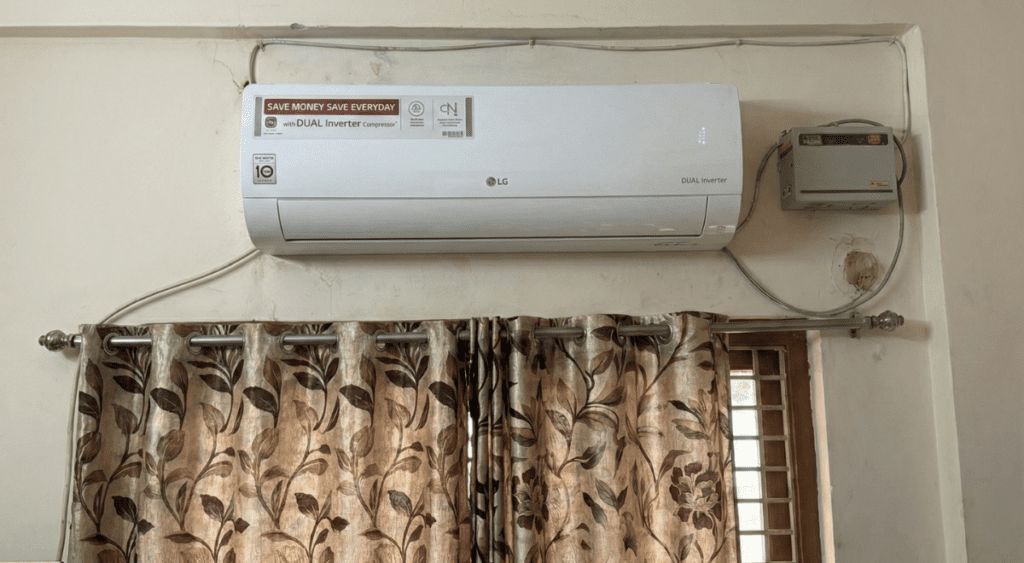
Best For: Renters | Low Voltage Areas | Coastal/Open Drain Areas
Link: [Check Discounted Price on Amazon India]
The Quick Verdict:
This is the “Sweet Spot” model for 70% of Indian homes. It balances high efficiency with extreme durability.
We recommend this QN Series over the newer 2026 models because it gives you the premium Ocean Black Protection and Wi-Fi without the ₹5,000 price hike of the “Energy Manager” series. It is built to survive bad voltage and bad weather.
Why it is perfect for Indian Conditions:
Tech Specs:
- ISEER Value: 5.20 (High Efficiency 5-Star).
- Cooling Capacity: 5000W Rated / 5800W Peak (Viraat Mode).
- Compressor: Dual Rotary Inverter (Variable Speed).
- Warranty: 1 Year Product, 5 Years PCB, 10 Years Compressor.
- Special Feature: Built-in Wi-Fi with ThinQ App control.
Pros:
- Service King: Spare parts (Motor/PCB) are cheaper and available even in Tier-3 towns.
- Smart Savings: “AI Convertible” mode automatically reduces capacity to 40% when the room is cool.
- Black Fin Protection: Proven to last 2x longer against corrosion than Blue Fins.
Cons:
- The “Invisible” Remote: The remote has NO Backlight. You will need to use the mobile app to change settings at night.
- Airflow: The throw is direct and powerful, which some people find less gentle than Daikin’s Coanda flow.
2. The “Heat Warrior”: Daikin 1.5 Ton 5 Star Inverter (MTKM50U)
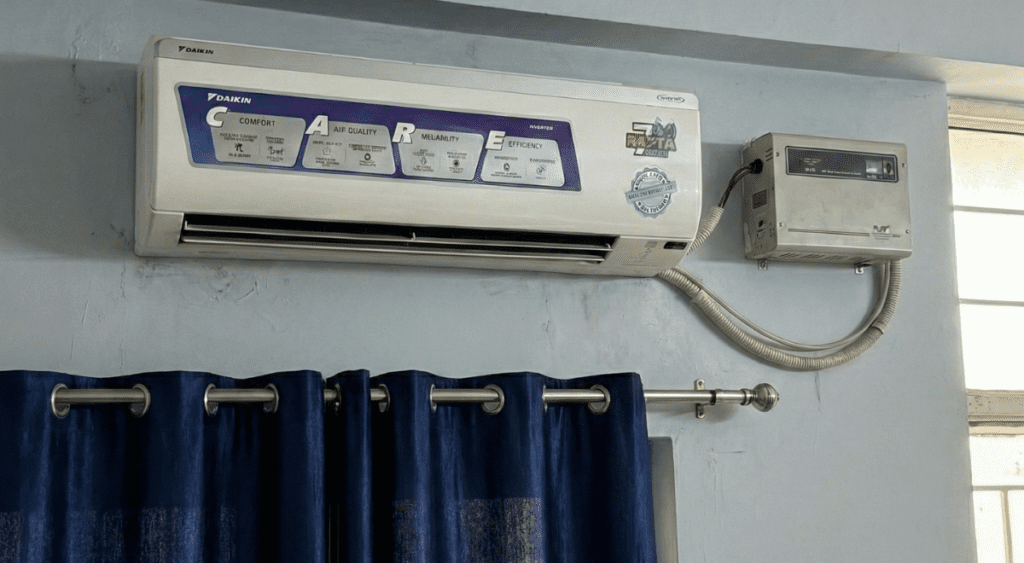
Best For: Top Floors | Silent Sleepers | Extreme Heat (48°C+)
Link: [Check Discounted Price on Amazon India]
The Quick Verdict:
The “Performance Beast” for extreme climates. While LG focuses on efficiency, Daikin focuses on raw cooling power.
It uses the legendary Swing Compressor, which is physically heavier and stronger than standard rotary compressors. If you live on a top floor or have a West-facing room that turns into an oven, this is the only machine that won’t “trip” at 48°C.
Why it is perfect for Comfort Seekers:
Tech Specs:
- ISEER Value: 5.20 (Top-Tier Efficiency).
- Cooling Capacity: 5280W (Higher actual capacity than most 1.5 tons).
- Compressor: Patented Swing Compressor (Low Friction).
- Warranty: 1 Year Product, 5 Years PCB, 10 Years Compressor.
- Display: Triple Display (Power %, Temp, Errors).
Pros:
- Silence: In “Quiet Mode,” the indoor unit is barely audible (whisper quiet).
- Real-Time Truth: The display shows the
- Power Consumption %, so you can physically see the electricity savings.
- Build Quality: Heavier outdoor unit with a larger condenser coil for better heat rejection.
Cons:
- The “Dongle” Tax: It is “Smart Ready” but usually requires buying a separate Wi-Fi kit (₹2,000) for app control.
- Maintenance Cost: PCB replacements are significantly more expensive (₹12k+) than LG if the warranty expires.
Critical Warning: Hidden Costs & Installation Traps
You can buy the best AC in the world, but these three “hidden traps” can ruin your experience.
Trap #1: The “Copper Pipe” Bill
Your AC comes with a standard ~3-meter copper pipe.
- The Reality: In modern high-rise flats, the outdoor unit is often placed far away.
- The Cost: Installers charge ₹300 per foot for extra pipe. If you need 5 extra meters, that’s an unexpected ₹5,000 bill. Ask the technician to measure the distance before he starts cutting.
Trap #2: The “Stabilizer-Free” Myth
Brands claim “Stabilizer Free Operation,” but this is risky.
- The Risk: If a sudden voltage spike burns your PCB, brands often reject the warranty claiming “External Electrical Fault.”
- The Fix: Buy a 4kVA Stabilizer (approx ₹2,000). Think of it as cheap insurance for your expensive ₹12,000 PCB.
Trap #3: The “Vacuum Pump” Mandate
Inverter ACs use R32 refrigerant. This gas is sensitive.
- The Scam: Lazy technicians will “purge” the air by releasing some gas. This is wrong.
- The Fix: You MUST insist they use a Vacuum Pump machine for at least 15 minutes.
- Why? If air stays in the pipes, it mixes with the gas to create acid. This acid eats your copper coil from the inside. This is why ACs leak gas after just 14 months.
Final Verdict: LG or Daikin?
Here is the final breakdown for your LG vs Daikin AC decision:
Choose LG If:
- You want lower maintenance bills.
- You live in a Tier 2/3 city or have voltage fluctuations.
- You need “Rough & Tough” protection against corrosion (Open Drains/Coastal).
Choose Daikin If:
- Performance is everything. You have a hot room and need powerful cooling.
- You want silence and gentle airflow (Coanda).
- You are okay with paying a premium for parts if they break.
My Personal Recommendation:
For 70% of Indian homes, the LG AI+ (QN Series) is the smarter financial choice. But if you live on the top floor under the blazing sun, the Daikin (MTKM) is the only one that will keep you cool at 2 PM.

